Ukraine's Drone Campaign Is Repeatedly Grounding Flights at Moscow-Area Airports
Repeated Ukrainian drone strikes have forced Moscow's main airports to suspend operations almost daily in October, and analysts say the pressure could extend to airlines, insurers and ticket prices.
By News Media House Staff ·
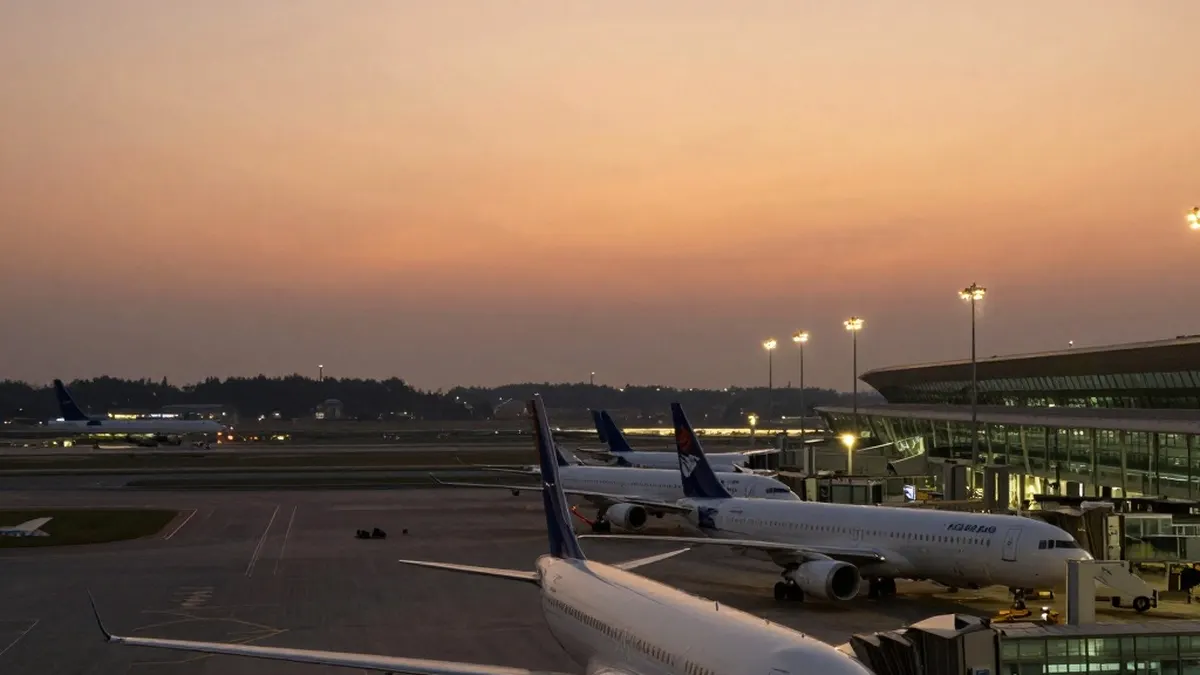
Ukrainian drone strikes have for months forced Russian airports to halt flights, and the disruption has intensified in October. According to the independent investigative outlet Agentstvo, Moscow's Domodedovo, Sheremetyevo, Zhukovsky and Vnukovo airports have had to suspend operations almost every day this month. On some days they were reportedly closed for as long as nine hours.
The campaign follows a stated goal from President Volodymyr Zelenskyy. In early September he said Ukraine would seek to cut off the airspace around Moscow and other Russian destinations. He addressed airlines, insurers and travelers directly: "Russian airspace will become completely unsafe." The next day, Ukraine sent a matching warning to the International Civil Aviation Organization. Ukraine's own airspace has been closed since Russia's full-scale invasion in February 2022.
Much of the disruption stems from a safety procedure run by Russia's aviation authority, Rosaviatsiya. Known as the "carpet" protocol, it immediately closes the airspace over a region or around affected airports if an aircraft violates Russian airspace, weapons are used or unidentified objects appear in the sky. Strict limits then apply to all air traffic. Oleksandr Laneckij, chief executive of the consultancy Friendly Avia Support, told DW that "essentially, every drone poses a military threat." He compared the situation to Yemen's Houthis, who significantly disrupted Saudi airspace, and said Ukraine's military capabilities far exceed theirs.
Military analyst Jan Matvejev said Ukraine would have little difficulty severely disrupting air traffic around Moscow, even though it has not yet fully closed Russian airspace as Zelenskyy intends. Triggering the protocol, he said, requires only simple drones without warheads or long range, and Ukraine's arms industry can produce hundreds of combat-ready long-range drones a day. Writing in The Atlantic in October, Simon Shuster, citing well-informed sources, said Ukraine's efforts are "just getting started."
Matvejev argued that Russian air defenses are not fully effective against the drones. "If it were possible to shoot them down, they would have done so by now," he said, adding that Russia would have deployed more air-defense troops if it had them.
Both experts warned about risks to civilian flights. Laneckij said Russia might lower the threshold for declaring the carpet protocol, raising the danger of deadly incidents like the 2024 Christmas day crash of an Azerbaijan Airlines flight. Investigators say that aircraft was hit by a Russian air-defense missile fired to counter drones, killing 38 people. Matvejev said little has changed in Russia's air-defense protocol since then. Against a low-flying drone that is visually identified and shot with a machine gun, the risk to aircraft is extremely low. Missiles are a different matter, since defects that are practically unavoidable in mass production could send one toward a nearby airliner.
Matvejev added that drones need no explosives to cause harm, because a collision with an airplane can be serious. A drone flown from Ukraine to Moscow must be fairly large, he said, "weighting dozens of kilograms." Airports elsewhere have also been affected: Ukrainian forces attacked the Pskov airport in the summer of 2023, and drone debris fell on Sochi airport earlier this month. Russia, for its part, has struck Ukrainian airports. In September Zelenskyy said Kyiv's airport and Boryspil, near the capital, were hit.
Whether foreign airlines keep flying to Russia, Laneckij said, will depend on three factors: the military threat, demand and insurance costs. If insurers rate the risk as very high, they could sharply raise premiums, sending ticket prices soaring. Competition in Russia's aviation market has already shrunk because many airlines have gone out of business, which has pushed up demand for seats on the remaining foreign carriers. "Whether they stay or not depends on the price they have to pay for the danger faced," he said.
Originally published by News Media House · Source: Deutsche Welle